Welcome 👋 At Mockly, we help non-native tech professionals succeed in English interviews. Start with the free interview guide ->
Behavioural interviews are not one-size-fits-all. A Software Engineer and a Product Manager might both be asked "Tell me about a time you handled conflict" — but the interviewer is looking for something very different in each answer.
This guide breaks down the 10 most common behavioural questions for six key tech roles, and explains what interviewers are actually listening for. At the bottom, you can download a free PDF with all questions grouped by role — ready to use in your interview prep.
What is a behavioural interview question?
Behavioural questions ask you to describe a specific situation from your past work experience. They usually begin with phrases like:
"Tell me about a time when..."
"Can you give me an example of..."
"Describe a situation where..."
The goal is to assess your soft skills — how you communicate, collaborate, solve problems, and handle pressure. In global tech companies, these are sometimes called "signals."
The best way to answer them is with the STAR framework: Situation, Task, Action, Result. Keep your Situation and Task brief (around 20% of your answer), and spend most of your time on the Actions you took and the Results you achieved.
Now, let's look at the questions that matter most — by role.
Software Engineer (SWE)
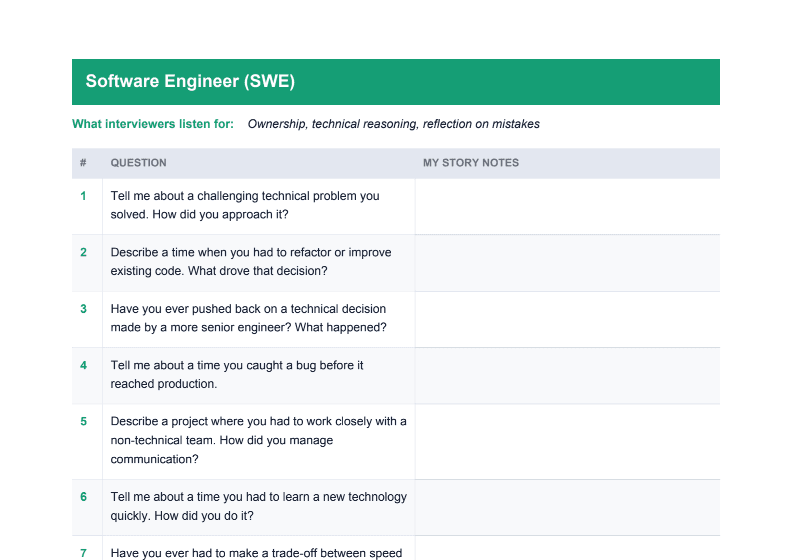
Interviewers hiring engineers want to know that you can solve hard problems, write maintainable code, and work well with others. They are looking for evidence of technical ownership, attention to detail, and the ability to communicate complex ideas clearly.
Tell me about a challenging technical problem you solved. How did you approach it?
Describe a time when you had to refactor or improve existing code. What drove that decision?
Have you ever pushed back on a technical decision made by a more senior engineer? What happened?
Tell me about a time you caught a bug before it reached production.
Describe a project where you had to work closely with a non-technical team. How did you manage communication?
Tell me about a time you had to learn a new technology quickly. How did you do it?
Have you ever had to make a trade-off between speed and code quality? What did you decide?
Describe a time when your code caused an issue in production. How did you handle it?
Tell me about a time you disagreed with a technical approach in your team. How was it resolved?
Give an example of a time you improved a development process or workflow.
What interviewers are listening for: Ownership of problems, clear technical reasoning, and the ability to reflect on mistakes without deflecting blame.
Product Manager (PM)
PMs are expected to align people, prioritise ruthlessly, and keep the user at the centre of every decision. Behavioural questions for PMs focus on judgment, stakeholder management, and how you balance competing demands.
Tell me about a product decision you made with incomplete data. How did you decide?
Describe a time when you had to say no to a stakeholder request. How did you handle it?
Tell me about a time a product launch did not go as planned. What did you learn?
Give an example of how you prioritised a roadmap when everything felt urgent.
Describe a time you gathered user feedback that changed your product direction.
Tell me about a time you worked closely with engineers to solve a complex problem.
Have you ever had to align multiple stakeholders who had conflicting priorities? How did you do it?
Tell me about a product you launched that you are most proud of. What made it successful?
Describe a time when you had to make a quick decision without enough time to research.
Give an example of how you used data to justify a product decision.
What interviewers are listening for: Clear thinking under pressure, user focus, and the ability to influence without direct authority.
Engineering Manager (EM)
Engineering Managers are assessed on how they build and support teams, handle performance issues, and balance technical depth with people leadership. Expect a mix of people management and technical judgment questions.
Tell me about a time you had to give difficult feedback to a direct report. How did you approach it?
Describe a situation where a team member was underperforming. What did you do?
Tell me about a time you had to hire quickly. How did you make sure you got it right?
Give an example of a time you had to make a difficult technical decision for your team.
Describe a time when your team missed a deadline. How did you handle it?
Tell me about a time you had to resolve a conflict between two engineers on your team.
How have you helped a junior engineer grow into a more senior role?
Tell me about a time you had to advocate for your team with senior leadership.
Describe a situation where you had to change how your team worked. How did you manage the transition?
Tell me about a time you had to deliver a project with limited resources or headcount.
What interviewers are listening for: Empathy, accountability, the ability to scale teams and processes, and calm decision-making under pressure.
Data Analyst / Data Scientist (DA/DS)
These roles sit at the intersection of technical depth and business communication. Interviewers want to know you can turn messy data into clear recommendations, and that you can explain your findings to people who do not share your technical background.
Tell me about a time your analysis led to a significant business decision.
Describe a situation where the data did not support what stakeholders expected. How did you handle it?
Tell me about a time you had to clean or work with very messy data. What was your approach?
Give an example of how you communicated a complex finding to a non-technical audience.
Tell me about a time you spotted an error in a dataset or report. How did you find it and what did you do?
Describe a time when you had to work with limited or incomplete data. What assumptions did you make?
Tell me about a project where you had to define the metrics yourself. How did you decide what to measure?
Have you ever disagreed with how a business stakeholder was interpreting data? How did you respond?
Tell me about a time you built a dashboard or reporting tool that improved a team's workflow.
Describe a time when an analysis you delivered was challenged. How did you defend or revise it?
What interviewers are listening for: Rigour, clear communication, and confidence in translating data into decisions.
UX Designer
Interviewers for design roles want to understand how you approach user problems, handle feedback on your work, and collaborate with engineers and PMs. They are assessing your design process as much as your output.
Tell me about a design decision you made based on user research. What did you find and what did you change?
Describe a time when you had to design under tight time constraints. How did you prioritise?
Tell me about a time your design was challenged by an engineer or PM. How did you respond?
Give an example of a time you simplified a complex user flow. What was the impact?
Tell me about a time you had to design for an edge case or an underrepresented user group.
Describe a time when user testing revealed something you had not expected. What did you do?
Tell me about a project where you had to work with limited user research. How did you manage it?
Give an example of a time you had to advocate for the user when business priorities were pushing in a different direction.
Tell me about a time your design did not perform as expected after launch. What did you learn?
Describe a time you had to align a team around a design direction when opinions were divided.
What interviewers are listening for: User empathy, clear design rationale, resilience to feedback, and cross-functional collaboration.
DevOps / Site Reliability Engineer (SRE)
DevOps and SRE roles require a blend of technical precision and calm under pressure. Interviewers focus on how you respond to incidents, build reliable systems, and improve processes over time.
Tell me about a major incident you were involved in. How did you respond and what did you change afterwards?
Describe a time you improved system reliability or reduced downtime. What did you do?
Tell me about a time you automated a manual process. What was the impact?
Give an example of a time you had to balance moving fast with maintaining system stability.
Describe a time when you had to debug a problem in a live production environment. What was your process?
Tell me about a time you identified a potential failure before it happened. How did you spot it?
Describe a situation where you disagreed with a developer about how something should be deployed. How did it get resolved?
Tell me about a time you had to communicate a system outage or degradation to stakeholders. How did you handle it?
Give an example of how you improved the deployment process for your team.
Describe a time when an on-call situation required you to escalate. How did you decide when to do that?
What interviewers are listening for: Methodical thinking, calm under pressure, blameless post-mortems, and a proactive approach to preventing failure.
Tips for answering behavioural questions in English
If you are a non-native English speaker preparing for interviews in the US, UK, or EU, here are a few things to keep in mind:
Use the STAR framework. It keeps your answers structured and easy to follow. Spend around 60% of your answer on the Actions you took — this is where interviewers get the most signal.
Add numbers where you can. Estimates are fine: "reduced manual work by around 30%" is better than no metric at all.
Prepare a story bank. Identify 5 to 10 strong stories from your career that can be adapted to different questions. A good story about handling conflict can also work for questions about communication, teamwork, or feedback.
Practice out loud. Reading your notes silently is not the same as speaking under pressure. Record yourself and listen back — this is the fastest way to improve your delivery.
Match the level of the role. For senior and lead roles, end your answer with a repeatable framework or system you now use: what you would do differently, or how you prevent the same problem in future. This signals seniority.
Download: Behavioural Interview Questions by Role (Free PDF)
We have put all 60 questions from this guide into a single PDF, organised by role, with space to add your own story notes.
What to do next
If you want to go further than just the questions, Mockly's English Interview Guide walks you through how to structure your answers, which soft skills each question is testing, and how to deliver your responses clearly and confidently in English.
Start with the Behavioural Interviews module — it covers the STAR framework in full, shows model answers across different tech roles, and includes tasks to help you build your own story bank.
Upgrade to premium to unlock full access
Ready for mock interviews? Get expert coaching