Welcome 👋 At Mockly, we help non-native tech professionals succeed in English interviews. Start with the free interview guide ->
Last month, we asked our Mockly Premium community, "Tell us the one thing your FAANG interview taught you."
Over 400 people responded at every level, from fresh grads to decade-long engineers, covering interviews at Google, Meta, Amazon, Apple, and Netflix.
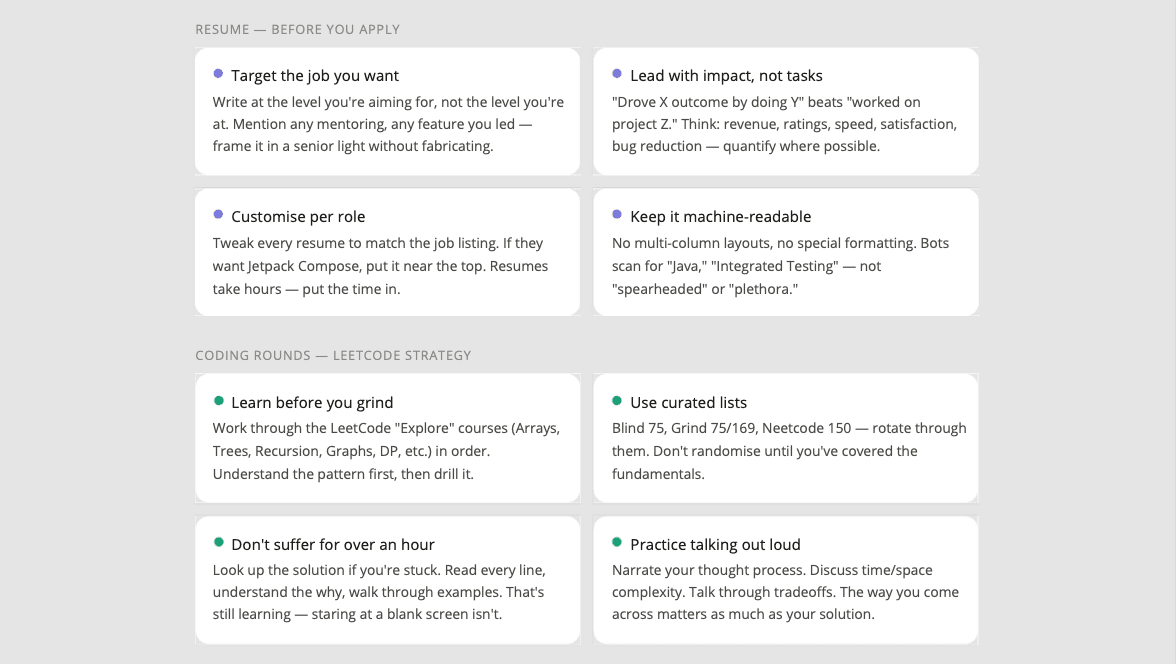
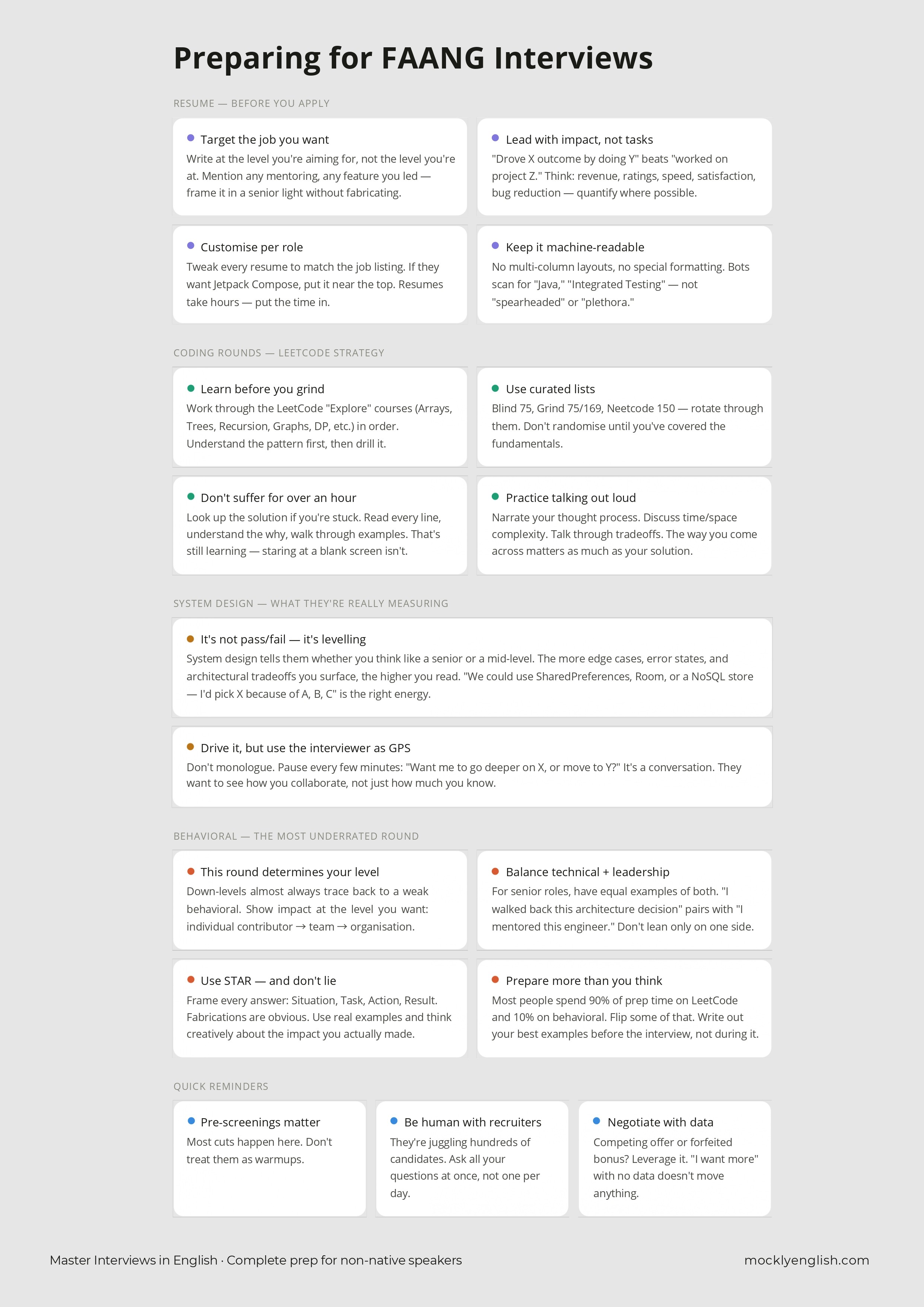
We collected and scraped the feedback, and compiled the most common tips in a handy cheat sheet.
Or, if you want to dive deeper into the top five, scroll down.
Lesson 1: Getting the optimal solution is worth less than you think
The instinct going in to the interview, especially for engineers who grew up on competitive programming, is to treat the coding round as a pure pass/fail. Did you find the optimal solution? Great, you passed. Didn't? You failed. Move on.
That's not how it works. Several readers estimated that actually producing a working optimal solution accounts for around 20% of what interviewers are evaluating. The rest comes from how you got there: explaining your reasoning as you go, walking through edge cases out loud, catching your own bugs in real time, and discussing the tradeoffs between a brute-force and an optimised approach.
"In the coding round, the interviewer asked me a lot of questions about my thinking. I didn't find an optimal solution, but they didn't seem bothered about this." - Software engineer, Meta
What this means in practice
Narrate your thought process continuously, even when you're unsure
Before coding, talk through time and space complexity of different approaches
When you spot a bug, say what it is and why — don't silently fix it
Missing one problem and communicating well often beats solving both in silence
Lesson 2: The behavioral round determines your level
Almost universally, our community who'd been down-leveled traced it back here. The behavioral interview is the primary mechanism interviewers use to figure out whether you're a mid-level contributor, a senior engineer with team-wide impact, or a staff-level leader with organisational reach. The same person can interview for senior and get leveled at mid — not because of their coding, but because their behavioral answers described impact that read as mid-level work.
The fix is to prepare stories at the level you're targeting. If you want senior, your examples shouldn't just show that you completed hard tasks with little oversight — they should show how your decisions affected the team, the codebase, or the roadmap. If you want staff, the impact should extend across teams or shape how the org works.
"I spent three months grinding LeetCode and maybe four hours on behavioral prep. I passed coding. I failed behavioral." — Android engineer
What this means in practice
Use the STAR framework (Situation, Task, Action, Result)
Emphasise the Result and quantify it (e.g. revenue, rating, load time)
If you can't quantify it, think broader: faster code reviews, fewer escalations, a new engineer onboarded successfully.
Lesson 3: System design is a conversation, not a presentation
A surprising number of people said they went into system design rounds with a carefully rehearsed structure, requirements, high-level design, low-level design, then a conclusion. They were surprised when feedback came back that they'd seemed rigid, or that the interviewer felt shut out.
Instead, you should be: making decisions, moving the conversations forward, proposing tradeoffs. But you stop every few minutes to check in. "I'm thinking we go deep on the caching layer here, does that seem right, or is there something else you'd want to cover first?" That small habit changes the dynamic completely.
"The interviewer gave me feedback that he liked how I kept asking him what mattered most."— Backend engineer, Google
What interviewers say they're measuring
Do you think at scale, or only at feature level?
Can you articulate tradeoffs clearly — not just name the right tool?
Have you seen enough edge cases that you raise them unprompted?
Do you work with the interviewer, or speak at them?
Lesson 4: You need to learn patterns before you can grind problems
Candidates who came into the process without strong CS fundamentals said that jumping straight into LeetCode mediums is demoralising and largely ineffective. The problems feel impossible until you understand the underlying patterns — backtracking, sliding window, two pointers, dynamic programming. Once you understand the pattern, the problems become variations on a theme.
The advice that came up most: use LeetCode's own learning courses (or equivalent resources) to work through concepts in order before touching a grind list. Arrays and strings, then stacks and queues, then trees, then graphs. Once you've touched each pattern deliberately, the Blind 75 or Neetcode 150 lists start to feel manageable rather than overwhelming.
How long does it take to become confident in Leetcode? Most candidates agreed it's around six weeks to genuinely learn the main patterns, then another six weeks of drilling across curated problem lists.
Lesson 5: The pre-screen and recruiter stages matter more than people realise
Candidates consistently noted that the early stages of the process are where most people are eliminated. Phone screens and recruiter conversations feel informal, and a lot of people treat them that way. But these are deliberate filters, and companies lean on them heavily precisely because interviewing engineers is expensive.
On the recruiter relationship specifically: candidates who did well described using their recruiter as a helpful resource. Asking smart questions early. Finding out the best way to reach them. Coming to every recruiter call with a list of questions written down, because that meeting is often when you're guaranteed a real answer, and because it signals that you're taking the process seriously.
I asked my recruiter what to focus on in preparation for the phone screen, and she basically told me exactly what to prepare."— Full-stack engineer, Amazon
Before your first recruiter call
Research what the phone screen format looks like for that specific company
Ask directly: "What should I prioritise to prepare for each stage?"
Ask all your questions at once, not one per email over two weeks
Find out their preferred communication channel — not everyone uses email
Upgrade to premium to unlock full access
Ready for mock interviews? Get expert coaching