Welcome 👋 At Mockly, we help non-native tech professionals succeed in English interviews. Start with the free interview guide ->
If you’ve ever opened LeetCode and felt overwhelmed by thousands of problems, you’re not alone.
Most people approach LeetCode the wrong way:
Random problems
Long weekend sessions
Memorising solutions
This isn’t a guide on how to “hack” interviews or memorise questions. The goal is to show you how to actually get better at problem solving — which is what interviews are testing.
Start with the basics
The most important thing is consistency.
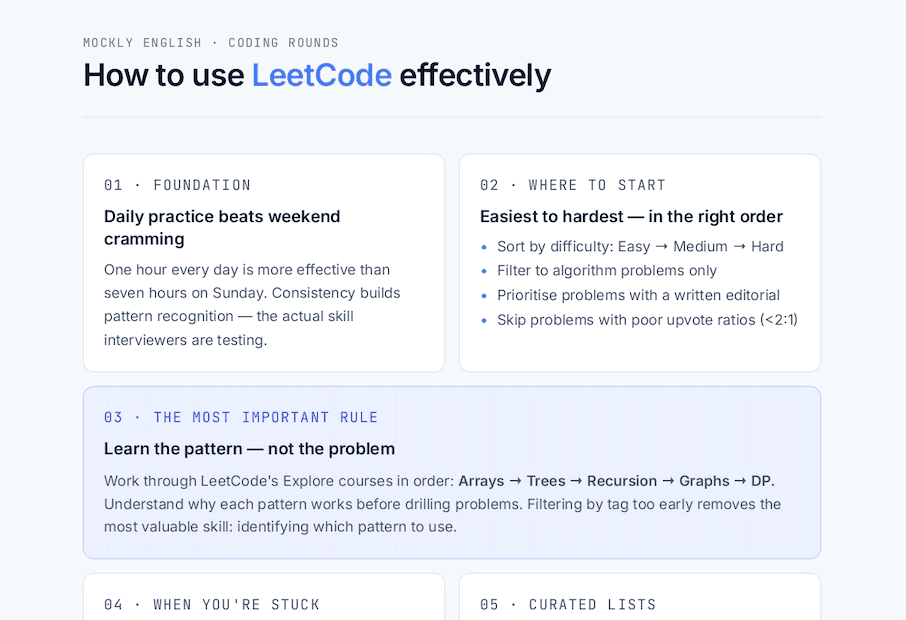
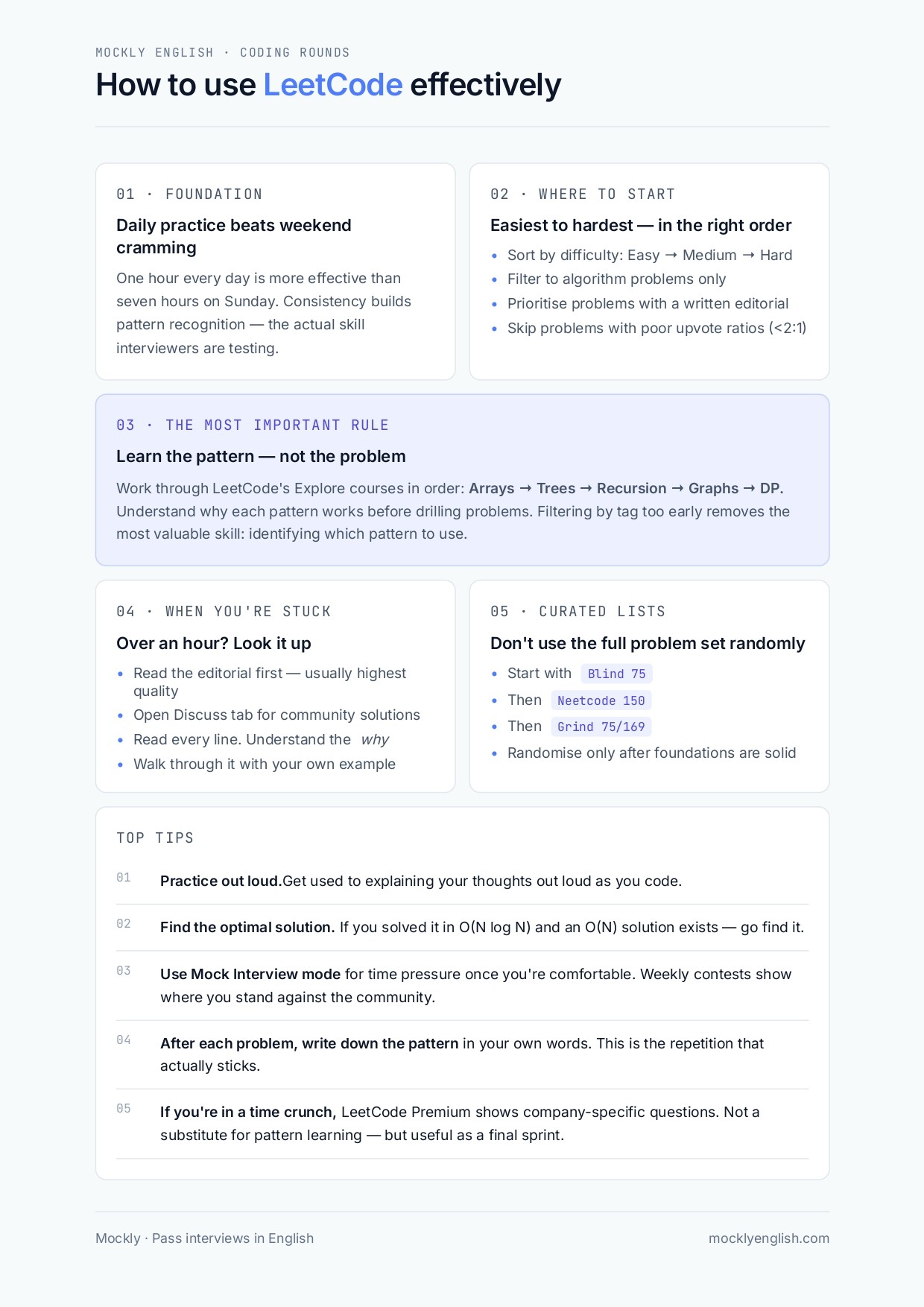
Doing one hour every day is much better than doing seven hours once a week. You build pattern recognition over time, and that’s what actually matters in interviews.
Also, make sure you’re actively thinking while you practice. If you’re tired or not focused, it’s fine to stop and come back later.
Everyone learns differently, so treat this as a guideline, not a strict system.
Focus on the right problems
If you’re preparing for general software engineering roles, focus on algorithm problems.
LeetCode now includes things like databases and shell, but your main focus should be:
Arrays
Trees
Graphs
Dynamic programming
Use the algorithms problem set as your base.
Where to start
Don’t pick problems randomly.
A simple setup:
Sort by difficulty: Easy → Medium → Hard
Start with unsolved problems
Prioritise problems with editorials
Avoid low-quality problems (low upvote ratio)
Not all problems are equal. It’s much easier to learn from well-written ones.
You can skip questions if they feel too easy — the goal is to stay challenged, not bored.
The most important rule
Learn the pattern, not the problem.
This is the biggest difference between people who improve and people who don’t.
Instead of thinking:
“I solved this question”
Think:
“This is a sliding window problem”
“This is DFS on a tree”
“This is binary search”
If you only remember the problem, it won’t help you in interviews.
If you understand the pattern, you can apply it anywhere.
Suggested order
Work through topics in this order:
Arrays
Trees
Recursion
Graphs
Dynamic programming
This helps you build up gradually instead of jumping into harder concepts too early.
What to do when you’re stuck
You will get stuck. That’s normal.
If you’ve been stuck for around an hour, don’t keep pushing blindly.
Instead:
Read the editorial
Check the Discuss section
Look at other explanations online
Then go through the solution carefully:
Understand each step
Run it with your own example
Make sure you understand why it works
The goal is not to “see the answer”, it’s to understand the idea behind it.
Don’t use the full problem set randomly
LeetCode has too many problems. You don’t need all of them.
Start with curated lists like:
Blind 75
NeetCode 150
Grind 75
These cover the most important patterns without wasting time.
Only start doing random problems once your foundations are solid.
How to improve faster
Solving problems is not enough on its own.
Here are a few things that make a big difference:
Practice out loud
Get used to explaining your thinking while you code. This is exactly what you’ll do in interviews.
Find the optimal solution
If your solution works but isn’t optimal, go back and improve it.
Write down the pattern
After each problem, summarise it in your own words. This helps it stick.
Add time pressure later
Once you’re more comfortable:
Try mock interviews
Do weekly contests
This helps you get used to solving problems under pressure.
About LeetCode Premium
If you’re short on time, Premium can show company-specific questions.
This can be useful, but it shouldn’t replace proper preparation.
Your goal is still to build general problem-solving skills, not memorise specific questions.
Final thoughts
LeetCode works, but only if you use it properly.
The key ideas are simple:
Be consistent
Focus on patterns
Learn from solutions
Don’t rush the process
If you follow that, you’ll improve much faster — and interviews will feel a lot more manageable.
If you want to turn LeetCode practice into real interview performance, the next step is learning how to explain your thinking clearly.
Learn how to communicate your solutions in technical interviews →
Upgrade to premium to unlock full access
Ready for mock interviews? Get expert coaching