Welcome 👋 At Mockly, we help non-native tech professionals succeed in English interviews. Start with the free interview guide ->
Today’s guest post is from one of our Mockly Premium community members, Julia Morozova.
After 31 applications and 22 interviews, Senior QA Engineer Julia shares everything she learnt from her interview experiences.
—
I moved from Moscow to Amsterdam in 2022. In early 2025, after two years at a Dutch e-commerce company, I decided I was ready for a new experience.
What followed in the next 6 months of interviews:
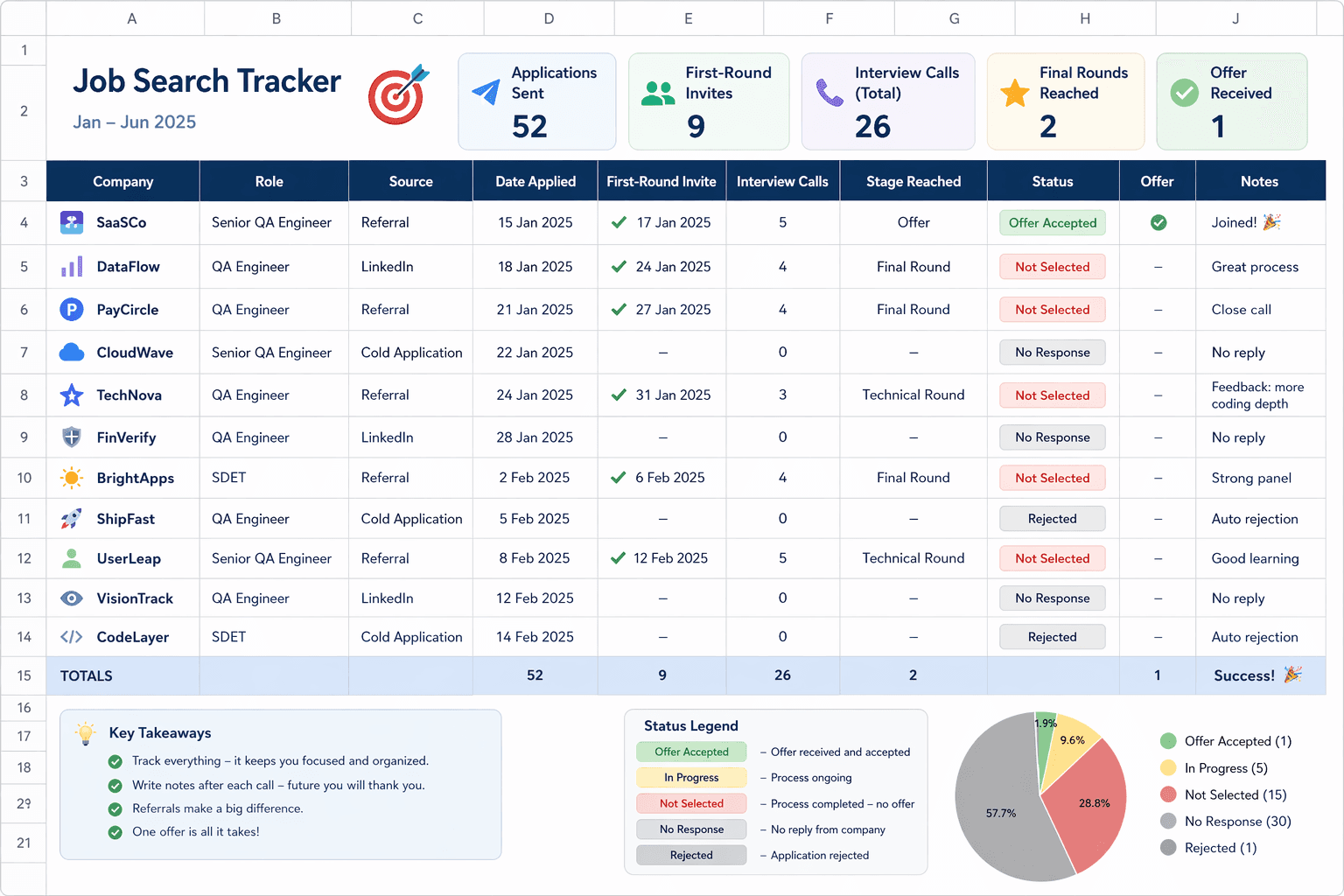
52 applications sent
9 first-round invites
26 interview calls in total
2 final rounds reached
1 offer received
I'm writing this having just signed a contract as a Senior QA at a SaaS company, still here in the Netherlands.
So, here is what I learned.
Referrals are extremely valuable
Small talk is not wasted time
Most tech companies interview the same way
Talking about yourself is a skill
Juggling multiple applications is harder than it looks
Cultural fit > technical skills
Referrals are extremely valuable
Referrals really matter in this market. From 'cold applications' I saw limited success. However, staying in touch with old team mates or classmates on LinkedIn and Telegram was incredibly useful. Actually, most of my first-round interviews actually came through referrals. Without that network, I’d probably look for communities to build those connections. (I know this is something that Mockly Premium offers).
Small talk is not wasted time
Every interview started with five minutes of warm-up. "How are you finding Amsterdam?", "Where are you based?". At the beginning, I think I was giving short closed answers and waiting for the serious part of the interview.
After a few sessions, I realised this small talk was kind of part of the assessment, a test of cultural fit, and what you're like as a team mate. I started preparing two or three casual responses before every call where I could openly share some more information about myself or part of my personality, and it created a more warm atmosphere to start the interview.
For example:
Interviewer: Hey Julia, how are you doing today?
Me: Good thank you. Keeping warm! It's snowing here in Amsterdam, it has been for a few days now.
Interviewer: Oh wow, I thought Amsterdam would have similar weather to London, but we rarely get snow.
Most tech companies interview the same way
I was surprised by how standardised the process was across companies. I only entered one FAANG interview process, however almost every company followed a similar style. They involved multiple consecutive rounds… a recruiter screen, a technical session, one or two behavioural interviews, and a final hiring manager call. Most companies had five or six sessions for a single role.
Talking about yourself is a skill
In Russia, job interviews are often quite transactional. You list your experience, they ask technical questions, you answer them. Talking about your achievements feels uncomfortable. So in my first English interviews I was extremely modest. I said things like "the team managed to reduce…" instead of "I introduced X to reduce…".
I then got some feedback from Revolut, they said 'own your impact'. It took me some time to get into the habit of talking about myself in this way.

Juggling multiple applications is harder than it looks
At my busiest, I had five active processes running at the same time, each at a different stage. Keeping the context straight, which company used which tech stack, what I had told which recruiter, which version of a story I had used in which interview, was exhausting. Add to that the emotional weight of waiting for decisions you cannot control, while still showing up energised for the next call.
I had to get good at tracking interviews, so I kept a simple spreadsheet and wrote notes after every session. Doing this as soon as the call ended was really helpful, and having the notes to review before the next stage made me more focused.
Cultural fit > technical skills
I got to the final round and was invited onsite to meet the team. The next day, the company told me they were still trying to decide between me and one other candidate.
They sent an additional at-home cultural-fit task with questions around communication and how I approach situations.
In the end, they offered the role to the other candidate.
That was difficult to accept at the time. But it made me realise that at senior level, technical ability is often assumed. What companies are really deciding is how well you align with the team and company.
This was a turning point and I started taking the “non-technical” parts of the interview much more seriously.
Summary
I expected the job hunt to take a while, but not 6 months! There were rejections that made me question everything! My English, my experience, my decision to move countries at all.
Looking back, what I underestimated was how much the soft skills and cultural layer of English interviews would matter. Learning to own my achievements, make small talk feel natural, and communicate with the right tone in English… these things took a while to realise, and took focused practice to fix.
Unfortunately, I only discovered Mockly half way through my job hunting search. If I had found it earlier, I think I could have halved the time it took to get a job.
The community, the guides, and having a space to work specifically on interview English made a real difference to how I showed up in those final rounds.
If you are preparing for English-language interviews, that is where I would start!
Upgrade to premium to unlock full access
Ready for mock interviews? Get expert coaching