Technical Interviews
How to Ask Clarifying Questions
Learn how to ask clarifying questions in technical interviews, confirm assumptions, uncover missing details, and create a clear plan before solving a problem.
Introduction
Clarifying questions are the questions you ask before solving a problem to make sure you fully understand it.
In technical interviews, questions are often left vague on purpose. Interviewers want to see whether you can dig deeper by asking the right questions.
Key Vocabulary
Let's review some key vocabulary related to clarifying problems before we get started.
Vocabulary | Definition |
|---|---|
Clarify | To make something easier to understand |
Vague | Not clear or detailed |
Use Case | A real-world example of how something can be used |
Assumption | Something accepted as true without proof |
Constraint | A rule or limit |
Edge Case | A rare or extreme input that could break the code |
What to Clarify
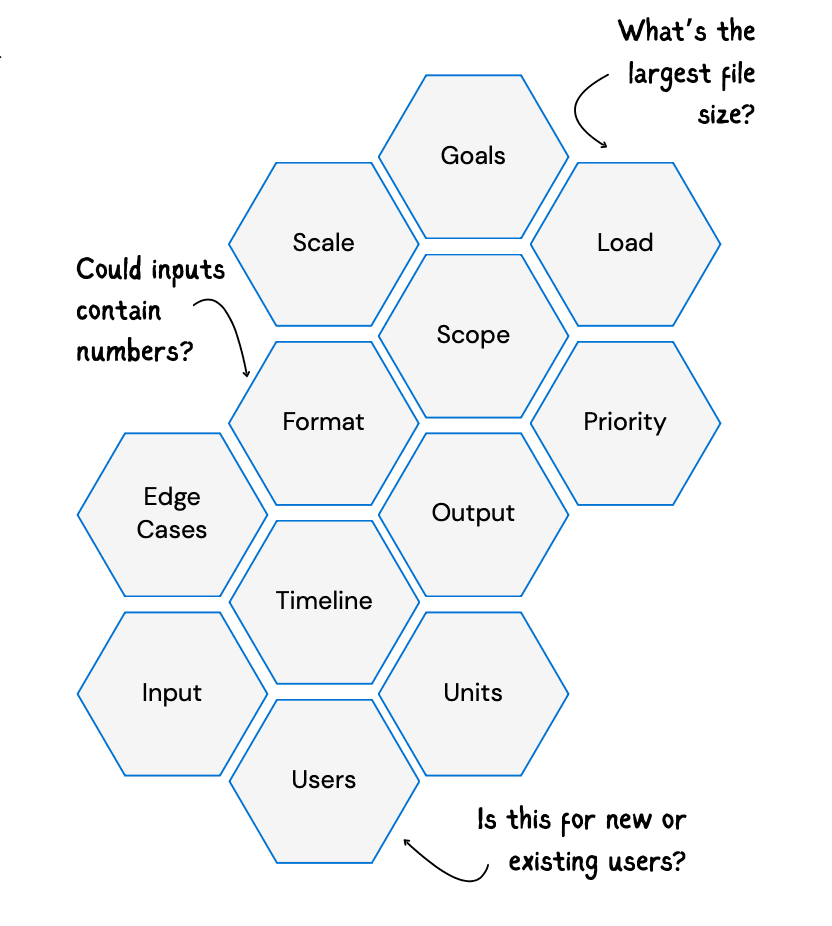
Ask questions to confirm details you’ve already been given, and to uncover anything important that hasn’t been mentioned.
Here are some examples of what you can ask questions about:
When to Clarify
The best time to ask clarifying questions is right after the interviewer describes the technical problem and before you start explaining your solution.
If you forget to ask something, you can still pause later:
“Actually, before I continue, should I…?”
Even if you think you fully understand, always ask a clarifying question.
This shows engagement and creates a collaborative environment — like working together, not being tested.
Answer Structure
Here’s how a technical interview usually plays out: the interviewer introduces a problem, and before solving it, you take a moment to ask clarifying questions.
Think of this structure as a checklist to ensure you fully understand the problem while showing a clear, methodical approach.
Checklist
Restate the problem
Ask clarifying questions
Confirm assumptions & constraints
Consider edge cases
Outline your process
See this in action in the model answer below.
Model Answer
Interviewer: You’re given a string, and you need to check if it’s a palindrome. How would you approach this?
Candidate: Ok, so you’d like me to check whether a given string reads the same forwards and backwards.
Should I ignore spaces and punctuation in the string?Interviewer: Good question. Yes, you can ignore all non-alphanumeric characters, and case.
Candidate: We should also think about handling edge cases, such as empty strings. Is it possible to have empty inputs?
Interviewer: Yes, it could be possible.
Candidate: Okay. I’m just thinking about the implementation now. Would you prefer that I do the reversal manually, or can I use built-in functions?
Interviewer: You can use built-in functions.
Candidate: Okay. I’m going to explain a high-level approach first, and then I’ll start writing some code.
Common Mistakes
1. Not confirming assumptions
If the interviewer doesn’t give more detail, clearly state your assumptions and explain why:
“Since the values represent number of people, I’m going to assume inputs cannot be negative.”
2. Asking vague questions
Avoid:
“How should I start?”
Use:
“Would you prefer I start with a brute-force or optimised solution?”
Get full access to English for Tech Interviews
Any questions? Get in touch