Getting Started
Writing Interview Notes
The secret to a smooth interview is strong notes. Find out what effective notes look like, what information they should include, and how to organise them so you can adapt your answers to almost any question.
Writing Scripts vs. Bullet Point Notes
When preparing interview answers, especially in a second language, many people write full scripts. It can be tempting to generate entire responses using AI, and it might feel safer, but relying on full scripts is not a good idea.
The disadvantages of using answer scripts:
• They’re long and hard to remember, especially under pressure
• They’re rigid – if the question is asked in a slightly different way, it’s hard to adapt
• Reading from the screen sounds unnatural and can make your delivery robotic
We recommend writing bullet point notes. These act as memory triggers... not full sentences, but keywords and short prompts that remind you of the answer you want to create.
What To Note
Here are some examples of things you should prepare for each interview answer.
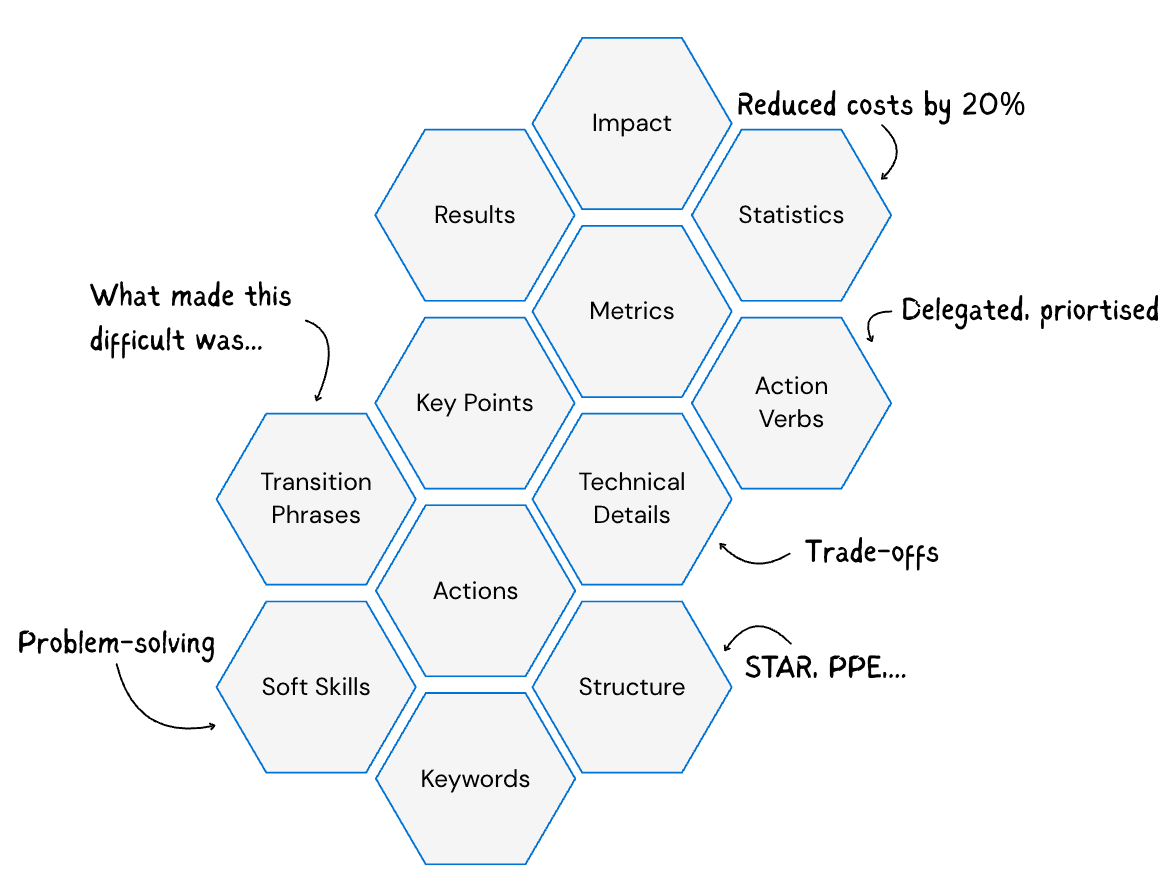
How to Format Your Notes
Use a digital note-taking app like Notion so you can easily reference your notes during preparation or in online interviews.
Notes should be readable and scannable.
Think simple, visual and easy to read with a quick look.
Example: Here, the candidate has written notes that can be reused for any interview question related to strengths.
Strengths |
|---|
|
These notes start with a headline skill (process improvement, communication), then support the skill with an example and a measurable result.
This structure makes the note easy to read at a glance. In the real interview, all the candidate needs to do is structure the notes into full sentences:
One of my key strengths is process improvement. For example, in my previous role, I used Python to automate data validation... This saved me around 4 hours a week in manual work and resulted in less errors.
Story Bank
What is a story bank?
A story bank is a collection of 5–10 stories from throughout your career that show examples of soft skills.
We recommend using story banks to prepare for behavioural, situational or cultural fit interviews, and using the STAR (or STAR-L / STAR-F) framework to write your notes.
Example story bank
This candidate writes notes on a story that could be adapted to any question about time management, prioritisation or taking ownership.
Delivered new feature under pressure |
|---|
S: Last-minute feature request during sprint T: Deliver MVP without delaying release A: Prioritised scope, created async doc, updated JIRA board R: Released MVP 2 days early, enabling earlier QA, got praised in retro L: Now flag risks earlier in planning 🏷️ Time Management, Prioritisation, Ownership |
Each story in your bank should have:
• A title, so it’s easy to identify
• Bullet points of key points
• Tags of 2–3 relevant soft skills
In the interview, these notes just need to be structured into full sentences.
During one sprint, we received a last-minute feature request that wasn't planned and….
My responsibility was to deliver an MVP version of the feature without delaying release…
I quickly prioritised the scope and…
We managed to release the MVP two days earlier than expected, which…
Since then, I've been more proactive in flagging risks…
Before each interview, you should make sure you have a story in your bank covering each soft skill mentioned in the job description.
Using the notes in the example above, the candidate will be ready to answer questions such as:
• Tell me about a time you worked under pressure.
• Tell me about a time you had to communicate important changes to your team.
• Can you give an example of when you took ownership of a project?
• How do you prioritise tasks when you’re facing tight deadlines?
Get full access to English for Tech Interviews
Any questions? Get in touch