Technical Interviews
Table of Content
Table of Content
Table of Content
Statements vs. Questions in Speaking
In technical interviews, it’s essential that the interviewer can clearly distinguish between your questions and statements. This page explains how to use correct word order and rising intonation to signal that you’re asking a question.
Introduction
A common mistake when translating directly from other languages into English is distinguishing between a question and a statement.
In technical interviews, it’s very important that the interviewer can tell when you are asking a question and when you are stating an assumption.
If this isn’t clear, your question might sound like a confident statement, which could cause confusion or make you seem overly certain.
Questions vs. Statements
In speaking, there are two main ways to show that something is a question:
Word order
Intonation
Combining both of these is essential to clearly show that you are asking a question rather than stating a thought or fact.
Word Order
When asking as yes/no question, the auxiliary verb or modal verb should always come first.
Statement | Question |
|---|---|
The input is always sorted. | Is the input always sorted? |
I should consider edge cases. | Should I consider edge cases? |
Intonation
Intonation is the rise or fall of your voice.
Statements usually have a flat or falling tone at the end.
Questions usually rise in pitch at the end.
This rise signals to the interviewer that you're expecting a response.
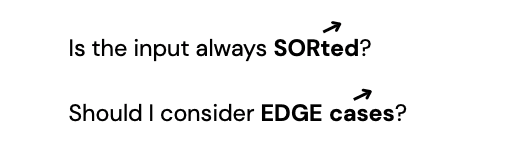
In the examples above, the capital letters indicate which part of the word/phrase should be stressed.
The arrows indicate that intonation should rise at the end of the question.
Introduction
A common mistake when translating directly from other languages into English is distinguishing between a question and a statement.
In technical interviews, it’s very important that the interviewer can tell when you are asking a question and when you are stating an assumption.
If this isn’t clear, your question might sound like a confident statement, which could cause confusion or make you seem overly certain.
Questions vs. Statements
In speaking, there are two main ways to show that something is a question:
Word order
Intonation
Combining both of these is essential to clearly show that you are asking a question rather than stating a thought or fact.
Word Order
When asking as yes/no question, the auxiliary verb or modal verb should always come first.
Statement | Question |
|---|---|
The input is always sorted. | Is the input always sorted? |
I should consider edge cases. | Should I consider edge cases? |
Intonation
Intonation is the rise or fall of your voice.
Statements usually have a flat or falling tone at the end.
Questions usually rise in pitch at the end.
This rise signals to the interviewer that you're expecting a response.

In the examples above, the capital letters indicate which part of the word/phrase should be stressed.
The arrows indicate that intonation should rise at the end of the question.
Introduction
A common mistake when translating directly from other languages into English is distinguishing between a question and a statement.
In technical interviews, it’s very important that the interviewer can tell when you are asking a question and when you are stating an assumption.
If this isn’t clear, your question might sound like a confident statement, which could cause confusion or make you seem overly certain.
Questions vs. Statements
In speaking, there are two main ways to show that something is a question:
Word order
Intonation
Combining both of these is essential to clearly show that you are asking a question rather than stating a thought or fact.
Word Order
When asking as yes/no question, the auxiliary verb or modal verb should always come first.
Statement | Question |
|---|---|
The input is always sorted. | Is the input always sorted? |
I should consider edge cases. | Should I consider edge cases? |
Intonation
Intonation is the rise or fall of your voice.
Statements usually have a flat or falling tone at the end.
Questions usually rise in pitch at the end.
This rise signals to the interviewer that you're expecting a response.

In the examples above, the capital letters indicate which part of the word/phrase should be stressed.
The arrows indicate that intonation should rise at the end of the question.
Upgrade to premium to unlock full access
Ready for mock interviews? Get expert coaching